Six pays représentent 40 % de la superficie terrestre de la planète, la Russie en tête
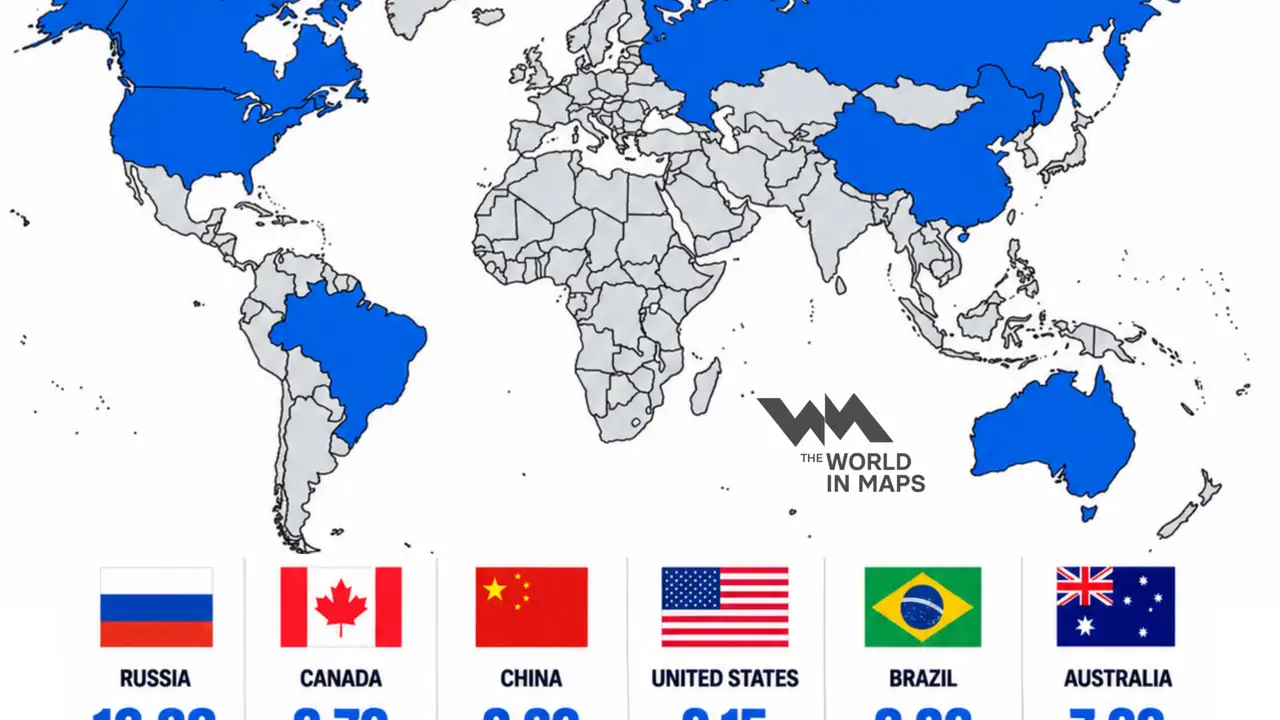
Six countries account for 40% of Earth's land area, led by Russia
Just six countries — Russia, China, the United States, Canada, Brazil and Australia — cover about 40% of the world's land area, highlighting how much of the planet is concentrated within a handful of national borders.

According to figures presented by World Visualized, the six countries occupy a combined 59.75 million square kilometres, compared with an estimated 148.94 million square kilometres of land worldwide.

Russia leads with approximately 16.38 million square kilometres of land, making it the world's largest country by a considerable margin.

China follows with 9.39 million square kilometres, ahead of the United States at 9.15 million and Canada at 8.79 million. Brazil covers approximately 8.36 million square kilometres, while Australia accounts for 7.69 million.

Together, these countries stretch across five continents and include some of the world's largest forests, deserts, agricultural regions and mineral reserves.

The figures measure land area rather than total territory, meaning inland waters are excluded. This distinction helps explain why Canada, often ranked as the world's second-largest country by total area, falls behind China and the United States when only land is counted.

The six countries also account for a substantial share of the world's population, with China and the United States among the most populous.

The World Bank's 2024 land-area figures confirm the six-country ranking, showing that geographical size remains heavily concentrated even though the world's population is spread across many more countries. 
Data

Three main points
1. Six countries cover about 40% of Earth's land.
2. Russia leads with 16.38 million square kilometres.
3. China ranks second, followed by the US and Canada.
Six countries account for 40% of Earth's land area, led by Russia Just six countries — Russia, China, the United States, Canada, Brazil and Australia — cover about 40% of the world's land area, highlighting how much of the planet is concentrated within a handful of national borders. According to figures presented by World Visualized, the six countries occupy a combined 59.75 million square kilometres, compared with an estimated 148.94 million square kilometres of land worldwide. Russia leads with approximately 16.38 million square kilometres of land, making it the world's largest country by a considerable margin. China follows with 9.39 million square kilometres, ahead of the United States at 9.15 million and Canada at 8.79 million. Brazil covers approximately 8.36 million square kilometres, while Australia accounts for 7.69 million. Together, these countries stretch across five continents and include some of the world's largest forests, deserts, agricultural regions and mineral reserves. The figures measure land area rather than total territory, meaning inland waters are excluded. This distinction helps explain why Canada, often ranked as the world's second-largest country by total area, falls behind China and the United States when only land is counted. The six countries also account for a substantial share of the world's population, with China and the United States among the most populous. The World Bank's 2024 land-area figures confirm the six-country ranking, showing that geographical size remains heavily concentrated even though the world's population is spread across many more countries. Data Three main points 1. Six countries cover about 40% of Earth's land. 2. Russia leads with 16.38 million square kilometres. 3. China ranks second, followed by the US and Canada.
Source: Six countries account for 40% of Earth's land area, led by Russia Just six countries — Russia, China, the United States, Canada, Brazil and Australia — cover about 40% of the world's land area, highlighting how much of the planet is concentrated within a handful of national borders. According to figures presented by World Visualized, the six countries occupy a combined 59.75 million square kilometres, compared with an estimated 148.94 million square kilometres of land worldwide. Russia leads with approximately 16.38 million square kilometres of land, making it the world's largest country by a considerable margin. China follows with 9.39 million square kilometres, ahead of the United States at 9.15 million and Canada at 8.79 million. Brazil covers approximately 8.36 million square kilometres, while Australia accounts for 7.69 million. Together, these countries stretch across five continents and include some of the world's largest forests, deserts, agricultural regions and mineral reserves. The figures measure land area rather than total territory, meaning inland waters are excluded. This distinction helps explain why Canada, often ranked as the world's second-largest country by total area, falls behind China and the United States when only land is counted. The six countries also account for a substantial share of the world's population, with China and the United States among the most populous. The World Bank's 2024 land-area figures confirm the six-country ranking, showing that geographical size remains heavily concentrated even though the world's population is spread across many more countries. Data Three main points 1. Six countries cover about 40% of Earth's land. 2. Russia leads with 16.38 million square kilometres. 3. China ranks second, followed by the US and Canada.

Seulement six pays, la Russie, la Chine, les États-Unis, le Canada, le Brésil et l'Australie, couvrent environ 40 % de la superficie terrestre mondiale, ce qui souligne combien de la planète est concentrée dans une poignée de frontières nationales.

Selon les chiffres présentés par World Visualized, ces six pays occupent au total 59,75 millions de kilomètres carrés, contre environ 148,94 millions de kilomètres carrés de terres dans le monde.

La Russie s'étend sur environ 16,38 millions de kilomètres carrés de terres, ce qui en fait de loin le plus grand pays du monde.

La Chine suit avec 9,39 millions de kilomètres carrés, devant les États-Unis à 9,15 millions et le Canada à 8,79 millions. Le Brésil couvre environ 8,36 millions de kilomètres carrés, tandis que l'Australie représente 7,69 millions.

RECOMMENDED FOR YOU

Israel coalition deadlock

Netanyahu met en garde contre une coalition soutenue par les Arabes alors qu'Israël fait face à l'impasse politique

Ensemble, ces pays s'étendent sur cinq continents et comprennent certaines des plus grandes forêts, déserts, régions agricoles et réserves minérales du monde.

Les chiffres mesurent la superficie terrestre plutôt que le territoire total, ce qui signifie que les eaux intérieures sont exclues. Cette distinction aide à expliquer pourquoi le Canada, souvent classé comme le deuxième plus grand pays du monde par superficie totale, est devancé par la Chine et les États-Unis lorsque l'on ne compte que les terres.

Les six pays représentent également une part importante de la population mondiale, la Chine et les États-Unis étant parmi les plus peuplés.

Les chiffres de la superficie terrestre de la Banque mondiale pour 2024 confirment le classement des six pays, montrant que la taille géographique reste fortement concentrée même si la population mondiale est répartie sur bien plus de pays.

Données

Trois points principaux

  1. Six pays couvrent environ 40 % des terres de la Terre.
  2. La Russie mène avec 16,38 millions de kilomètres carrés.
  3. La Chine arrive en deuxième position, suivie des États-Unis et du Canada.

This story is written and edited by the Global South World team, you can contact us here.